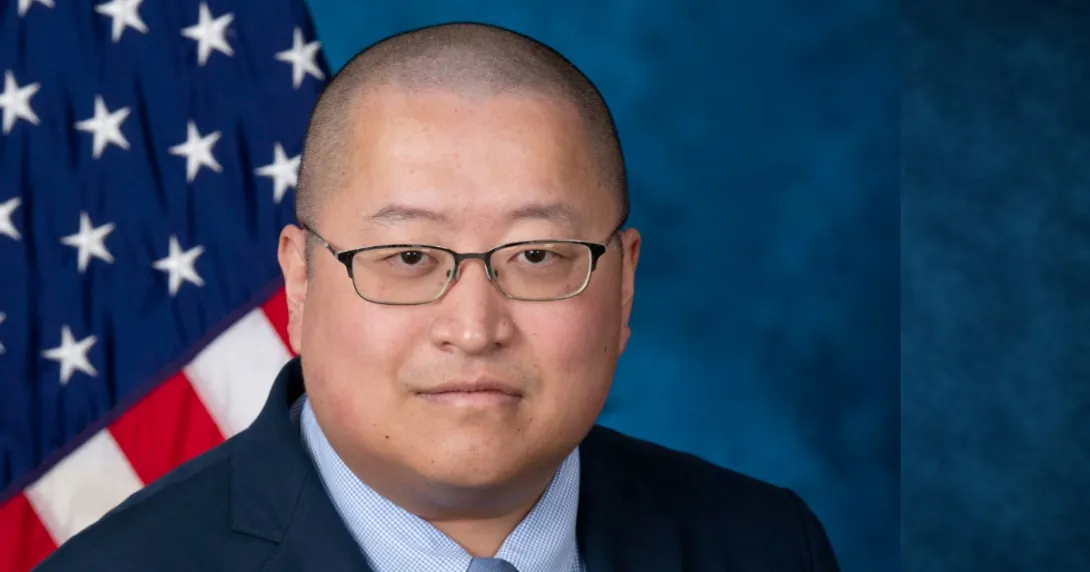
Mark Zhang, acting assistant under secretary for health at the U.S. Department of Veterans Affairs
Photo courtesy of the U.S. Department of Veterans Affairs
MobiHealthNews’ Emerging Technologies Series spotlights organizations developing, scaling and investing in innovative healthcare technologies. What follows is Part 1 of a seven-part series:
Mark Zhang, acting assistant under secretary for health at the U.S. Department of Veterans Affairs, sat down with MobiHealthNews to discuss how innovation is taking shape across the VA, including the evolution of its technological advancements and the BioBone initiative, which explores 3D printing a patient’s own tissue for precision medicine.
MobiHealthNews: Can you talk about the different aspects of the VA where innovation is really flourishing?
Mark Zhang: Maybe before I start, I'll give you a little bit of my history. I'm actually fairly new to the VA. I joined the VA about a little under two years ago, and prior to that, I had a career in digital innovation at Brigham and Women's. I was an informatics fellow, palliative care doctor.
Before there was even an Office of Innovation, the VA has been a leader in innovation, just like they're a leader in clinical and research for so many years. So many firsts came from the VA. The first liver transplant, the nicotine patch, the pacemaker and a leader in EHRs. Before EHRs were cool, the VA was doing it. And a lot of it was because – personally, this is my opinion – it's the best mission in the business for healthcare. Best mission, unique population and because we're such a mission-driven organization, people are driven to just do the right thing, and it pushes medicine forward.
So, when I joined the VA, I came at a pivotal time. I'm actually the second leader officially for the Office of Healthcare Innovation and Learning, and the first leader really did the heavy lifting of just creating this office, coalescing a lot of other program offices across the organization to have one focus around innovation for VHA, and we do so much. When I think about the scale and scope of the innovation, we have five offices dedicated, and they each have different kinds of flavors and sweet spots.
No. 1 is the Innovation Ecosystem, and that really is what I would think of as our front lines for innovation. When I think about a traditional innovation office supporting great ideas from staff, supporting and liaising with external companies that want to engage or external parties, the Innovation Ecosystem really creates that. Creating programming and networking and also supporting our regional innovation centers, which we have over five across the nation. That's the Innovation Ecosystem.
Our office also is the Office of Healthcare Innovation and Learning (OHIL). The learning is a lot about simulation. So, part of OHIL is simulation, and SimLEARN is the office that supports simulation for the whole organization, and we have a flagship world-class simulation center in Orlando, plus some obviously sim centers in many of our medical centers across the nation.
MHN: I imagine the learning aspect is incredibly important because the patients that you're treating are very specific.
Zhang: Absolutely, absolutely. So it's not only just training for staff, but I think innovation and learning across the board. We always try to keep our vision and our mission focused on the veterans. So anytime we can engage with veterans, learn from them, both learn but also help assist and teach, we try to do that. All of our offices enable that.
Our third office is Advanced Manufacturing. So, 3D printing. We make what we cannot buy.
And then our fourth office is actually the Center for Care and Payment Innovation, which is essentially our equivalent of CMMI. So they're the office that thinks about, how do we focus better care at a reasonable ... you know, value-based care is really their focus.
And then finally, the last office is X_Labs, which is our DARPA for VA.
And all of these offices were guided around one central North Star, and that is really supporting the hopes, the dreams and the future for veteran care, our staff and the organization. So everything we do is around that.
MHN: When you think about emerging technologies, are there technologies that you are hesitant to quickly implement?
Zhang: So, I think, of course, AI is incredibly powerful and absolutely has the zeitgeist of not only healthcare, but also, I think, just all industries at this point, and the VA is absolutely working toward implementing AI in a responsible and safe way across both our clinical aspects and also other places.
Innovation, of course, plays a role in that. In fact, one of the key things we've done in this space is around ambient dictation efforts across the organization. So we did a tech sprint challenge model a couple of years ago to kind of evaluate what's best in class in the field, and SimLEARN was actually a key participant in actually doing that kind of bake-off.
The common saying in Silicon Valley and tech is move fast and break things. I'm not sure we can do that in healthcare. I don't think so, but I think the ethos of trying to move fast responsibly is absolutely something that I think innovation is trying to do in the constraints of the reality of the type of work we do, which is taking care of real people, veterans. They deserve the safest and most effective things, as do all Americans and anyone who requires healthcare.
MHN: Can you tell me about X_Labs?
Zhang: Part of what we're trying to do, and why we invested in this Biofab capability, is that the underlying technology right now is supporting the BioBone effort. X_Labs is an incredible, world-class sterile lab inside the Seattle VA Medical Center, and the underlying technology could eventually support future goals like, potentially, something like 3D printing organs and other tissues, but right now, the current project we're using that facility for is the BioBone effort.
MHN: What is BioBone?
Zhang: The concept of BioBone is, what if we could enable 3D printing, but for tissues? If 20th-century medicine was about being evidence-based, 21st-century medicine is going to be all about leveraging technology and hyper-personalizing it, whether it's through genomics, whether it's through artificial intelligence. But I think the next frontier is, what if we can 3D-print new parts of you based on you? And that is really the concept of BioBone is that big idea.
And they are starting with, as the title kind of alludes, bone. The idea is, can we leverage state-of-the-art 3D printing technology, along with the veteran's tissue, to create perfectly matched bone for procedures? Right now, I think they're primarily focused on oral maxillofacial surgeries. I think it's all about what is currently feasible for a minimum viable kind of product. But the idea is, can we leverage this new technology to make hyper-personalized care even more personalized for the future?
And this is being done by X_Labs, which is our DARPA for VA, and really, their sweet spot is supporting the translation of cutting-edge research to the bedside. And there's this valley of death where things need support. And really, what X_Labs is tasked to do, and they are still a very new office, just to be clear, is to help bridge that valley of death and support these moonshots that, if not the VA for veterans, may not have the support to move forward.
To me, a lot of what innovation brings to the table is being that lighthouse for incredible ideas, always looking to the future, always with a veteran at the top of mind.