Photo courtesy of The University of Queensland
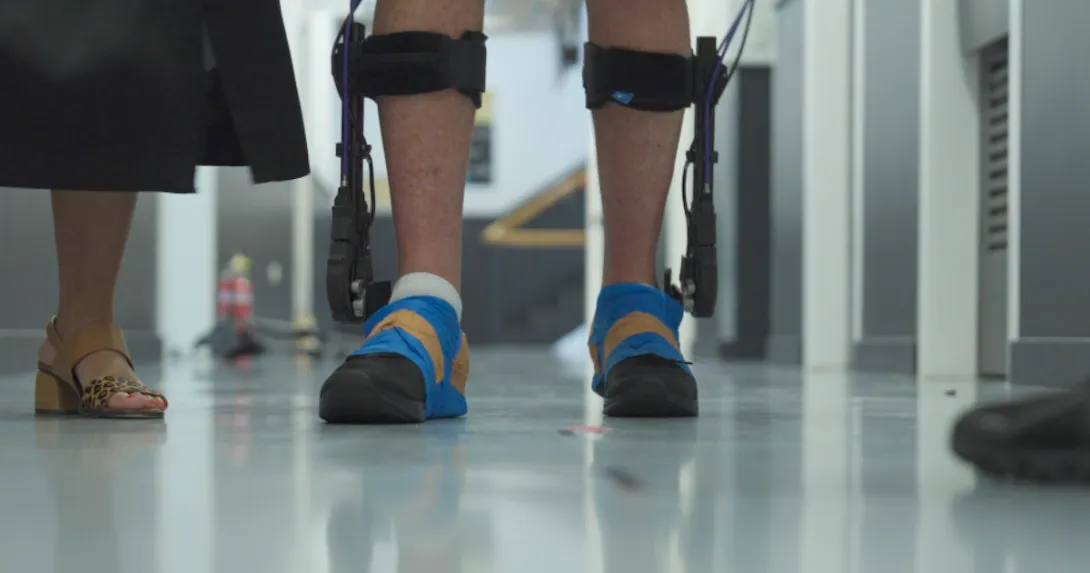
Researchers from The University of Queensland have created a wearable robotic exoskeleton to help people living with motor neuron disease walk for a long period, with plans to introduce AI functionality to personalise assistance.
Its development is part of the iMOVE-MND project, funded by the ALS Association, which is exploring the impact and feasibility of wearable robotic devices as a mobility aid for people living with MND – a group of rare neurodegenerative disorders that selectively affect motor neurons, which control voluntary muscles of the body.
"The device is the first of its kind in Australia, and it's a world-first to trial it on participants with MND," claimed UQ School of Biomedical Sciences associate professor Dr Taylor Dick, who leads the project.
HOW IT WORKS
The device consists of a lightweight, untethered wearable system with a small waist-worn unit housing the control electronics, mini-motors and batteries, connected by cables that transmit mechanical assistance to the ankle joints.
It uses sensors to detect force through the foot and applies step-by-step mechanical assistance for ankle plantarflexion and dorsiflexion during walking.
The wearable exoskeleton also comes with a companion mobile application.
The goal is to allow users to take more steps in a day while minimising fatigue, according to Dr James Williamson, a UQ School of Biomedical Sciences postdoctoral fellow who is leading the technical development of the wearable exoskeleton.
A second generation of the wearable exoskeleton is now being tested, he told Mobihealth News, featuring upgraded sensors and machine learning to personalise assistance.
"This updated design incorporates user feedback gained from our first-generation device. Improvements include hardware changes that make the device lighter and more ergonomic, as well as software updates that enhance the delivery of assistance at the ankle."
"Early feedback from participants who have worn this updated device has been extremely encouraging," he claimed.
Machine learning, he explained, has been applied to help design an exoskeleton control system that better responds to environmental challenges. "Our comprehensive 3D gait analysis approaches will underpin the development of these machine learning methods," he added.
Future implementations, he told this publication, "may allow users to control the device through voice commands, which would benefit those who may find manipulating a smartphone challenging."
The UQ research team is also planning to test the device over longer periods to track its performance as MND progresses. A 3D gait analysis, involving 3D optical motion capture, force plates embedded in a treadmill, and electromyography, is part of this test.
THE LARGER TREND
Robotic exoskeletons are currently widely applied in rehabilitation to help restore mobility. Researchers from Hong Kong Polytechnic University, for example, introduced in 2023 a mobile "ankle-foot exoneuromusculoskeleton" specifically designed to support the rehabilitation of stroke patients with hemiplegia. Last year, Korean robotics manufacturer WIRobotics also launched a wearable AI-powered exoskeleton for gait assistance, also designed for seniors and people recovering from lower-body injuries. Chinese company RoboCT also develops a rehabilitation exoskeleton to help people dealing with lower limb injuries relearn gait.
A/Prof Dick said they applied the concept "differently to help people [with MND] maintain walking function and independence as the disease progresses."
"We will continue to work closely with the MND community to improve the accessibility of these technologies," said Dr Williamson.
The iMOVE-MND project also comes as the UQ unveiled the Centre for Motor Neurone Disease Research earlier this year, touted as the first centre in Australia to integrate discovery, translational, care, and clinical trial research on MND.