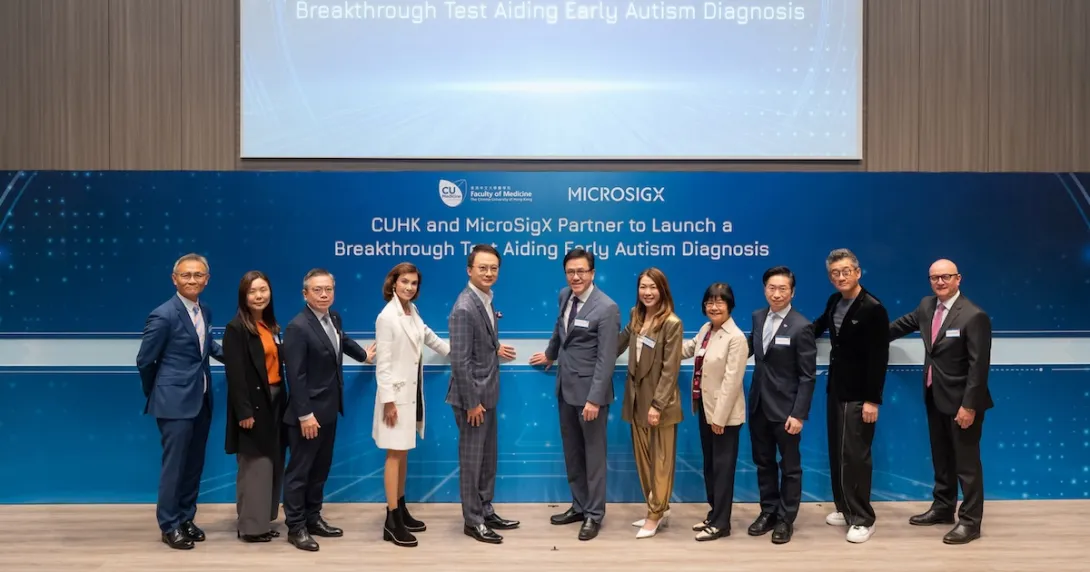
Photo courtesy of the Chinese University of Hong Kong
An AI-powered stool test designed to assess early autism risk in children will be piloted for free in Hong Kong, as its developers pursue international regulatory expansion.
The Chinese University of Hong Kong Faculty of Medicine (CU Medicine) and its spin-off company MicroSigX Biotech Diagnostic Ltd. recently unveiled what could be the world's first AI-powered multi-kingdom microbial biomarkers test for autism spectrum disorder (ASD) in children.
HOW IT WORKS
This invention, according to CUHK, was based on a 2024 CU Medicine research, published in Nature Microbiology, that identified changes in four kingdoms of microbial species in the gut microbiome of children with ASD.
"We can measure microbial signatures from a small faecal sample, analysing bacteria, archaea, fungi, and viruses, along with their genes and metabolic pathways. This data is processed through a validated AI model to generate an ASD risk score," explained Dr Siew Ng, professor and associate dean of Research at CU Medicine, in a media release.
In a validation study, the stool test has shown over 95% negative predictive value, ruling out autism. "This provides reliable information to help exclude low-risk cases, enabling better allocation of medical and social resources to high-risk groups while alleviating parental concerns," said Dr Sandra Chan Sau-man, professor at CU Medicine Department of Psychiatry.
The patented test received Breakthrough Device Designation from the United States Food and Drug Administration in July 2024.
CU Medicine launched the spin-off company, MicroSigX, to introduce the AI stool test for autism globally, with backing from the Hong Kong government's Research, Academic, and Industry Sectors One-plus Scheme, or RAISe+. The company is currently preparing registrations with China and the US.
WHY IT MATTERS
Global autism incidence is now about four times higher than two decades ago. CUHK notes that in Hong Kong alone, cases of children diagnosed with autism have gone over 22,000, and continue to rise.
The university points out that mass referrals of children with suspected autism symptoms, which leave many families anxious while awaiting specialist assessment, have created an unmet need for better risk stratification.
CU Medicine, together with MicroSigX, will begin piloting the AI stool test from January next year, working with non-profit partners and neurodevelopmental specialists to form a cross-disciplinary team that supports early autism risk assessment and planning.
The partners will offer free MSX Metagenie tests to 200 eligible preschool children aged 18 months to 4 years with suspected autism symptoms but no formal diagnosis, with enquiries and registration handled via a dedicated WhatsApp hotline.
CU Medicine also announced its plan to establish an Advancement Centre for Autism to develop training programmes for community healthcare professionals, while MicroSigX looks to set up a Centre of Excellence for ASD.
THE LARGER TREND
In South Korea, where new ASD cases are also trending upwards, government-backed projects by leading universities are also utilising AI to discover autism biomarkers through a living laboratory, detect the condition early, and personalise ASD management.
Early this year, research from Japan demonstrated the use of eye-tracking technology to detect autism early. Eye tracking is also applied in EarliTec Diagnostics' US FDA-approved solution. Cognoa's Canvas Dx is a similar 510(k)-cleared autism diagnostic aid for children.
Meanwhile, SpaceGut launched last year what could be the first AI-powered at-home gut microbiome test service in Malaysia, aiming to provide personalised recommendations for an individual's gut health.