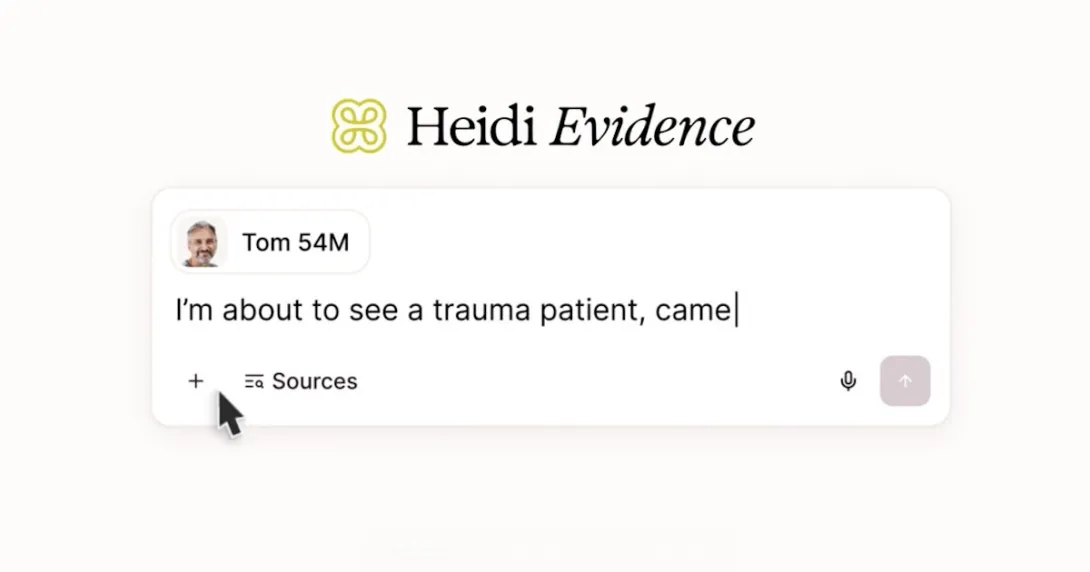
Photo courtesy of Heidi
Australia-based startup Heidi has unveiled a new medical research tool on its AI-powered clinical documentation platform, alongside the announcement of its acquisition of a clinical AI startup based in the United Kingdom.
WHAT IT'S ABOUT
According to the company, its free tool on the Heidi AI Scribe, called Heidi Evidence, provides concise summaries with transparent citations and verbatim excerpts.
Heidi disclosed that Evidence is in part built on Anthropic's Claude models, which it said are "particularly well suited to high-stakes healthcare environments," given its strength in "interpreting complex, unstructured clinical conversations, synthesising dense medical literature, and generating accurate, grounded outputs."
Evidence features authoritative sourcing, having integrations with HealthPathways, EMGuidance, MIMS, Vidal, NICE, and BMJ Group, among others, "to reflect regional standards and formularies." Heidi is also keen to get the electronic medical information resource, UpToDate, on board, CEO Dr Thomas Kelly mentioned in a comment on a LinkedIn post.
Addressing a question in the same post, Dr Kelly said the app "should work for almost all specialties [right] out of the gates[;] it will use sources based on your location and specialty."
Also comes as a standalone tool, Heidi Evidence is free from ads, with the company stressing its "permanent commitment to non-commercial, auditable data, ensuring clinical decisions are never influenced by advertising."
Heidi explained that, unlike other commercial AI tools that monetise via ads and data, it uses "enterprise revenue to subsidise access for practitioners."
Another selling feature of Heidi Evidence is the Source Control and Library. "We allow individuals and organisations to choose their preferred sources, upload their own proprietary documents, and create collections of those sources for different teams within their org[anisations]," Dr Kelly explained in his LinkedIn post.
"Where Evidence is integrated with Scribe, Heidi can now apply evidence across your visits, creating multi-day summaries, cited PDF explainers, styled Word documents, audit spreadsheets, tables, and more."
WHY IT MATTERS
A new contender in this space, where OpenEvidence – currently valued at $12 billion – and DoxGPT currently dominate, Heidi Evidence is being set apart for its emphasis on clinical integrity amid the growing necessity of AI use to help doctors keep up with ever-updating medical knowledge.
"We believe that for AI to be a true care partner, the integrity of its evidence must be non-negotiable," Dr Kelly was quoted as saying in a media release.
"Bringing transparent, clinical-grade insights into the room makes it easier to deliver quality care, but that information must be free from the ambiguity of commercial influence," the company stressed. By keeping the tool ad-free, it said, Evidence ensures clinicians that their decision-making is "built on pure clinical rigour, not a business model."
THE LARGER CONTEXT
The launch of its AI medical research tool came alongside the announcement of its acquisition of AutoMedica. The startup's AI framework and access to the Medicines and Healthcare products Regulatory Agency's (MHRA) healthcare AI sandbox, MHRA AI Airlock, as part of its pilot cohort, will help extend Heidi's existing footprint in the UK, the company shared in a statement.
Heidi also recently unveiled Heidi Comms for healthcare teams, which assists with coordinating patient communications across calls, bookings, reminders and follow-ups.
In October, Heidi raised $65 million in a Series B funding round for its global expansion. With offices in the United States, Canada, Australia, New Zealand and the United Kingdom, the company aims to bring its AI offerings to Ireland, France, Spain, South Africa, Hong Kong, Germany and Singapore. Heidi is now valued at over $450 million and has raised close to $100 million in investments.
The company's AI scribe is also one of the four currently endorsed by the New Zealand government for use within the public health system. It is also being piloted in public emergency departments across the country.